“The manna ceased on the day they ate the produce of the land, and the Israelites no longer had manna; they ate the crops of the land of Canaan that year.” vs. 12
The writers of Israel’s history believed that God had led the Hebrews out of slavery in Egypt and had given them the land of Canaan as their territory. Most of us simply accept the story and are impressed by the generosity of God–we’ve heard about the conquest of the Promised Land since Sunday School and have sung about the battle of Jericho with gusto. Few of us have given a second thought to the inhabitants of the land, the Canaanites who fought bravely against the desert invaders and who were slaughtered, men, women, and children, as the Hebrews gradually took their cities. It’s an old, old story, that tale of invasion and conquest, and we’ve seen it being played out in real time during this last month as the Russians have established themselves in the cities of Ukraine. Like the Hebrews they insist that the land is theirs, and their religious leaders have supported the claim. In their mind this is divine destiny, a reclaiming of what had been given them by God. We humans are good at such power grabs, and we almost always claim that God is on our side. No wonder peace is in such short supply–will our greediness and lust for power ever be satisfied? Thank God for the Jesus story! It really is humanity’s only hope!
Thought for the Day: Why do some religious leaders support war?
“He replied, ‘Sir, let it alone for one more year, until I dig around it and put manure on it. If it bears fruit next year, well and good; but if not, you can cut it down.’” vss.8-9
When we study scripture we tend to fall into the either-or trap–either this is true or that is true. For example, either we’re saved by grace or we’re saved by works, and we choose whichever “truth” suits our fancy at the time. Many people are comfortable with such dualistic thinking–it’s certainly what we’ve gotten used to in religious conversation. The problem is that this style of interpretation results in a pretty narrow view of scripture and we end up twisting passages to fit our particular bias. It’s a real blessing when we can put aside those dualisms and simply accept whatever is being said in any particular text. In this text Jesus is obviously saying that people are expected to bear fruit. When they don’t there is a grace period, a time for absorbing nutrients. If they still don’t bear fruit, that’s it! Those who have hung their hats on unconditional love have a tough time accepting the harshness of Jesus’ words. Their tendency is to engage in interpretive gymnastics to permanently extend the grace period. But that’s not necessary if we accept the truth of both grace and works. Are works essential? Of course! Is salvation by grace? Of course! We need both these truths to lead a fruitful, peaceful life!
“He asked them, ‘Do you think that because these Galileans suffered in this way they were worse sinners than all other Galileans?’” vs. 2
Occasionally we catch a glimpse of everyday events in scripture, a little window into what kind of things happened perhaps on a daily basis. In this little fragment saved by Luke we find out that there had been some deaths in the city of Jerusalem, several caused by an act of terror by Pilate, the Roman governor, and eighteen others killed in a construction accident. Then, as now, it was thought that the victims were being punished for their sins, but Jesus quickly corrects that foolish thinking. Sometimes stuff just happens and innocent people are killed–we might not like it, but that’s how life is! But then Jesus goes on to say that there are consequences for careless living, and he warns his listeners to shape up. From the beginning of his ministry he’d been telling people to repent, to completely change the direction of their lives. As people weaned on grace we don’t really like that message–we’d rather be told that there is no need to change, that we can keep on doing dumb stuff and that’ll be okay. But that’s not how it is! Our life in Christ will be marked with continual repentance and change, and we’ll be loved every step of the way. God loves us too much to allow us to stay the way we are!
“These things happened to them to serve as an example, and they were written down to instruct us, on whom the ends of the ages have come. So if you think you are standing, watch out that you do not fall.” vss. 11-12
Paul was obviously a brilliant person, but he seems hopelessly naive in thinking that the Corinthians are going to learn lessons from the behaviors of their ancestors. If they did learn anything, it would be pretty much of a miracle, because we know from our own experiences that humans are dense when it comes to learning lessons from the past. Instead we do the same hurtful things that others have done before us. That’s why we keep waging murderous and violent wars again and again. In fact, the leaders of AA tell us that the definition of insanity is “doing the same thing over and over, each time expecting different results.” Many parents know this human frailty from watching their children grow up. No matter how many times they are warned about self-destructive behavior, sometimes from personal experience, they seem to pay little attention. Of course, we can’t give up attempting to instruct succeeding generations–like Paul we’re obligated to teach our children and lift up the sins of the past. And some will listen! Some do learn and their lives are blessed. And even if they continue to stumble and fall, our merciful God will never forsake them!
Thought for the Day: What lessons did I learn from my parents?
“Nevertheless, God was not pleased with most of them, and they were struck down in the wilderness.” vs. 5
Paul was anxious to remind the Corinthians that just because they were baptized and gathered regularly for Holy Communion they didn’t need to worry about leading lives pleasing to God. He points out that their Hebrew ancestors had all passed through the sea and had eaten manna in the wilderness and had still managed to screw up their lives big time. And he’s right! And the same thing is still happening! Baptized Christians, some of whom are active in congregations, behave in the most despicable ways. They live immoral and deceitful lives and then are surprised when things go south for them. It’s like all the Christian stuff is a facade, like a shiny exterior designed to meet some sort of societal expectations. Their hearts are untouched and their behavior embarrassing. Paul says that those who live by grace are held to the highest standards. It’s not that God is watching every step we take and will strike us down for our sins. We don’t live by rules and laws. But because we don’t, more is expected of us. In recent weeks, baptized Christians have engaged in horrendous acts of violence and destruction, and have claimed that they are acting in the name of Christ! No wonder the world is not impressed–these folks make a mockery of the faith!
Thought for the Day: Why doesn’t faith make folks decent?
“Because your steadfast love is better than life, my lips will praise you. So I will bless you as long as I live; I will lift up my hands and call on your name.” vss. 3-4
Almost a half century ago, back before amplifiers replaced acoustic guitars, folks in evangelical congregations regularly heard the song “Thy Loving Kindness” and loved its catchy harmonies. “Thy Lovingkindness is better than life, Thy Lovingkindness is better than life. My lips shall praise thee, thus will I bless thee, I will lift up my hands unto thy name.” The words come from this psalm and reflect the ageless feeling of gratitude we feel in the presence of the Lord. It’s not that the psalmist was a Pollyanna type, one who never had a bad day. He reports that he often felt spiritually barren, like one lost in desert without a drop of water to be found. But there were times, perhaps in the temple, when the love of God overwhelmed him and he burst out with songs of praise and thanks. Some of us know what that is like. Occasionally the presence of a lover evokes such a feeling, sometimes it’s the company of saints in a worship service at our favorite church, or maybe it’s a moment of solitude on a frenzied day. God knows we need such interludes, especially at a time like this when the world seems to be teetering on the brink of disaster. The joyful thoughts are an oasis in the wilderness–and at least for a few minutes we are lifted up!
Thought for the Day: What’s my favorite praise song?
“For as the heavens are higher than the earth, so are my ways higher than your ways and my thoughts than your thoughts.” vs. 9
Even though the prophet regularly refers to God as the Lord, it’s likely from what he says that he would also be comfortable with “Divine Mystery” as a way to think of God. The Israelites had been struggling for hundreds of years to get a handle on God but times kept changing and their ideas about God shifted too. Their great insight had been to understand God as an invisible One whose primary name was Yahweh, more of a verb than a noun. And now the prophet had realized that people just can’t get a verb into a God-box–God’s essence was beyond human understanding. People continue to struggle with their understanding of the Divine–Christians developed the doctrine of the Trinity and used definitions from Greek philosophy, and for some that was enough. But others have continued to wrestle with the Divine like Jacob in the wilderness, and answers about the nature of God are hard to come by. Wherever we find ourselves in this great quest, it’s probably best to acknowledge that God or the Divine Mystery is at the heart of all that is, and that the Divine Presence is made manifest in unconditional love and mercy. That doesn’t answer all the questions, but for most, it is enough!
Thought for the Day: When is God most accessible to me?
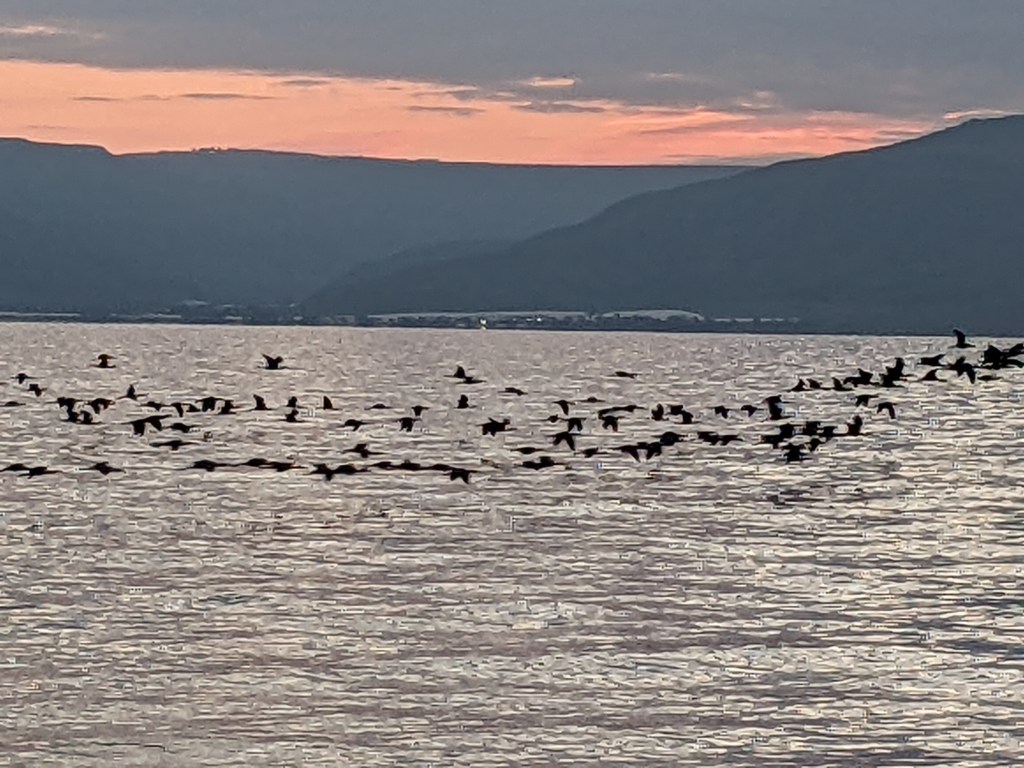
It’s impossible not to have expectations on a Holy Land Trip, but itinararies are made months in advance, verified at the last possible moment, and things don’t always work out. This morning at the beautiful Ron Beach Hotel on the Sea of Galilee I had set my heart on sharing sunrise with the travelers. I told them to get up about a half hour before dawn and join me on the lakeside–and a few actually did it! And we were greeted with clouds on the eastern horizon! We watched for a time, hoping for a miracle, all the while marveling at the birds making their way from north to south as they have each day for thousands of years. Jesus saw them when he lived here, and now we were seeing them too. It was an amazing point of contact and gave us an appreciation of the creation connection that was surely present in his sunrise meditations. “Consider the birds of the air…:” he said to his disciples, and this is what he was remembering!
Birds of the air at dawn on the Sea of Galilee.
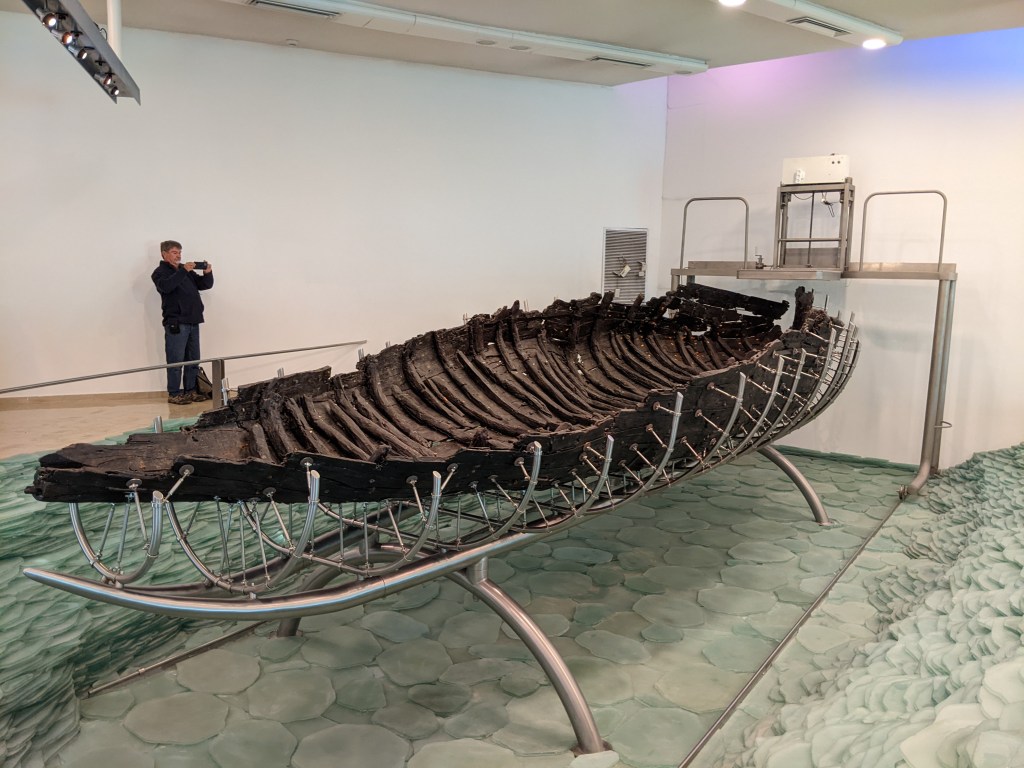
A couple hours later, dressed and fed, we boarded the bus for a ride to the Tiberius docks to catch our boat for the scheduled trip on the lake–just as Jesus had done–but it didn’t work out. We were bumped from the schedule! Only our guide’s quick planning brought a solution. We rode the bus to the “Jesus Boat” visitors center at the Ginnosar kibbutz and were treated to a video about the recent discovery of a first century boat, and then a view of the actual boat. And then we got our ride on the Sea! And it was better than it would have been. The sun was out and the wind had ceased, and our voyage was spectacular, full of song and dance and beautiful views. Again we saw what Jesus saw!
The First Century “Jesus Boat”
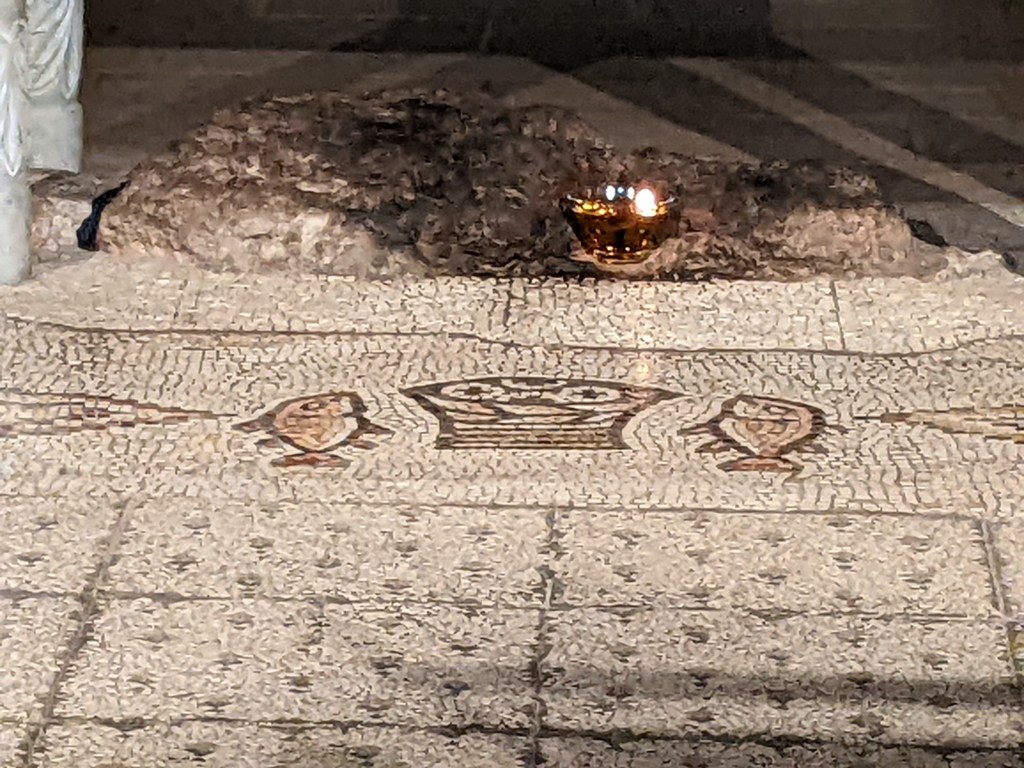
We had four more stops to make as the day continued and for a time it seemed like we were in charge again. The Mount of the Beatitudes was wonderful and a solemn setting for our service of Holy Communion with an emphasis on “Blessed are the poor in spirit” and “Blessed are the meek.” All ate and were satisfied, just like the folks Jesus had fed on the hillside, as commemorated at Tagba, where we paused to see the iconic mosaic of the loaves and the fishes, following our stop at Capernaum, the hometown of Jesus.
Loaves and Fishes at Tagba
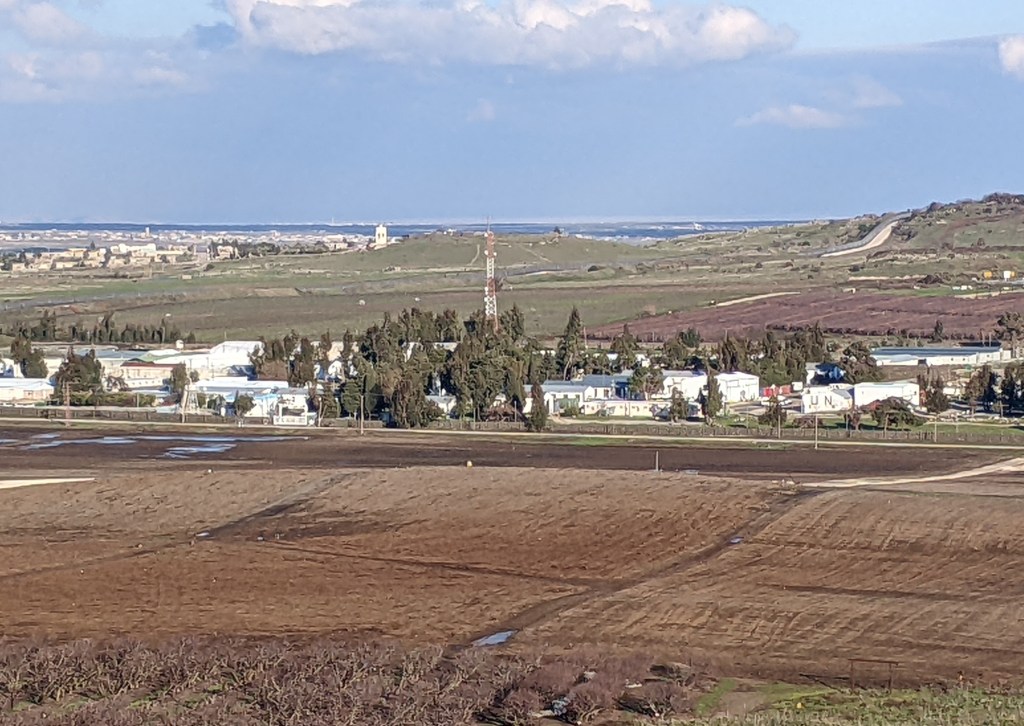
After lunch it seemed as though we were back on track again as we sped through the fertile valley of Hula on our way to Banias in Caesarea Phillippi. It was a long drive and we were looking forward to seeing the headwaters of the Jordan and the ruins of the Pan temple. Our guide had been telling the story of Peter’s confession there and we were ready to walk and hit the restrooms–or maybe it was the other way around. But the entrance was chained and we were turned away, full bladders and all. Again, our driver and guide consulted and a new plan was hatched. A quick stop at rest stop calmed us, and we proceeded north through the Golan Heights to the Syrian border. We saw the Jordan raging under a bridge, white water and all; snow had fallen and remained in the fields with the white slopes of Mt. Hermon in the background. On a hill overlooking the Syrian border we saw Syrian villages, the demarcation line and the UN peacekeeping camp. What a treat! A vivid reminder of the 1967 war. None of us had expected this–and we returned to the Ron Beach rejoicing. We’d gotten some lemons, but the lemonade was delicious!
The UN camp with Syrian villages on the hillside
Tomorrow we drive to Jerusalem and there’s rain in the forecast. The way it’s been going I expect sunshine!
“Why do you spend your money for that which is not bread, and your labor for that which does not satisfy? Listen carefully to me, and eat what is good, and delight yourselves in rich food.” vs. 2
The prophet was an astute observer of his peers and had discovered that a large number were dissatisfied and unhappy. It wasn’t that they were broke and unemployed. Like many of us they had jobs and earned a reasonable wage, but they spent their money foolishly and their labor seemed pointless. Again, a familiar story! The prophet proposed a change of focus–what they needed to do was pay more attention to their diets! Of course he’s talking about what might be called “soul food,” the spiritual nourishment that comes with a more intimate relationship with God. Folks in our time are still struggling to discover that rich food the prophet was referring to. Most of us have more money than we ever dreamed of and a huge range of employment opportunities, but we’re still dealing with spiritual poverty. Contentment can be elusive. We struggle to make sense of life and keep wondering if there isn’t some magic potion or drug that could give spark to our life and dull our inner ache. Many have found that satisfaction in their faith, a commitment to Christ that leads them into a life of service and caring. They may not be getting rich, but their contentment is off the charts!
“Jerusalem, Jerusalem, the city that kills the prophets and stones those who are sent to it! How often have I desired to gather your children together as a hen gathers her brood under her wings, and you were not willing!”
When it comes to metaphors we love to talk and sing of God as being like an eagle, one who lifts us up out of danger with strong wings and amazing strength. But that’s not the metaphor Jesus used for himself as he thought about the people of Jerusalem. Instead he describes himself as a chicken, a mother hen who gathers her brood under her wings. It’s that more feminine image that probably comes closest to describing what it is that trust in Jesus brings to our lives. Because the truth is that we are seldom air-lifted out of our troubles, instead we get a Lord who comes offering shelter and comfort in the midst of pain and strife. Many of us know what that feels like. We’ve experienced it in the strong embrace of friends when tears flow and times get tough. We’re not removed from our circumstances, we’re protected! What pained Jesus was the reluctance of hurting people to accept his gentle touch. They liked to stare at him and see miracles, but they didn’t want to be hugged! We know folks like that too! They want to be tough and self-reliant–and they miss out on the blessings of vulnerability! How sad!
Thought for the Day: What feelings come with being hugged?